
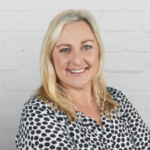

Living with cerebral palsy didn’t stop Dr David Chapman from earning praise for his Macquarie University PhD. But when default accessibility tech frustrated him, the award-winning Egyptologist took matters into his own hands, teaching himself coding and fine-tuning custom AI models to decode ancient history and pave the way for a more inclusive future.
Three thousand years ago in Thebes, a group of temple officials decided to rob a Royal memorial temple and plunder some tombs in the Necropolis. They were caught, interrogated, and remarkably the court transcripts survive. For Dr David Chapman, who spent five years reconstructing the lives of the priests of the god Montu from thousands of fragments scattered across the world’s museums, it’s moments like these that bring the ancient world rushing back to life.
“The people we study aren’t just the objects they leave behind – the nice coffins, the beautiful reliefs,” he tells me in our latest series of Game Changers. “They were humans, with their own methods of survival, their own ambitions, their own way of being in the world.”
David, 30, from Tweed Heads in northern NSW, has just completed a PhD in Egyptology at Macquarie University – a thesis that his examiner from Oxford hailed as “a major advance in the state of research”. This earned him the Vice-Chancellor’s Commendation for Postgraduate Research to sit alongside his University Medal. He achieved all of it while living with cerebral palsy. And that, he’s quick to point out, is ‘not a sad story’.
“While there were significant challenges in terms of managing how I worked, it’s by no means a sad story,” he says. “My disability gave me a perspective to notice smaller details that sometimes go overlooked.”
Solving puzzles, ancient and modern
Ask David what first drew a young Australian to ancient Egypt and the answer says everything about how his mind works. “I’m fundamentally interested in complex puzzles and how societies work and there’s no greater case study than Egypt.”
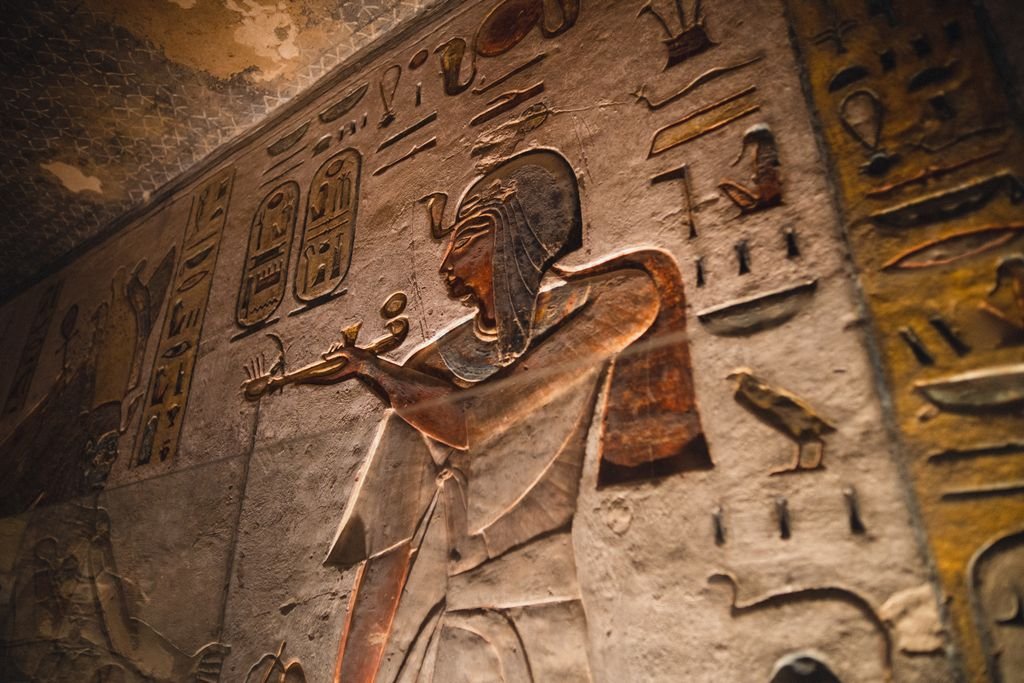
His doctoral research pieced together the “household” of Montu, the falcon-headed war god of Thebes – the high priests, god’s fathers, scribes and, yes, the occasional thief who kept one of Egypt’s great temple institutions running. Temples, he explains, were the ancient world’s major institutions: significant landholders, large employers and community centres rolled into one.
When times grew difficult, people behaved as people do. David notes that the temple and tomb robberies reflected economic hardship and weakening centralised state control. “It’s a very interesting case study of what happens when a society is placed under significant stress.”
It’s this insistence that ancient history is useful – not esoteric – that animates him. “The fundamental unit of any society is a human being,” he says. Whether it’s how a temple economy functioned without money, or how a society responds to widespread corruption, “there’s an enormous amount we can learn. These skills can be applied to any complex problem.”
A master of languages, past and present
Untangling those complex ancient networks required a deep mastery of languages. David’s linguistic toolkit spans millennia and continents. For David this includes being multi-lingual across ancient and modern times, or as he says in his classic self-deprecating way, “I know enough to be dangerous.”
Just take a look at an entry from his CV.
- Ancient Scripts & Languages: Proficient in Old, Middle, and Late Egyptian (including hieroglyphs and hieratic script) as well as reading Latin.
- Modern Languages: Advanced academic German (with conversational B1 fluency) and reading proficiency in French.
- Linguistic Range: Possesses a broad research interest in Indo-European and Afroasiatic linguistics.
During our conversation, David also shared how he enjoyed picking up puns, and witticisms while reading hieroglyphs. “You must be one of the few people in the world who understands what Ancient Egyptian humour would have been like?,” I venture. His answer is suitably modest: “Not necessarily — there’s always something lost in the gap between the past and the present,” he said. “But occasionally there’s a funny joke, or a sly allusion to another situation, and there’s a glimmer of recognition and I think: ‘Ah, now I see what you’re trying to get at’.”
When the technology fails you, build your own
Partway through his PhD, David taught himself Python and SQL to wrangle his vast, fragmentary dataset. For him, technology has always been about efficiency: it’s a necessity, not a luxury. “Part of living with a disability is about operating as efficiently as possible with the resources you have at your disposal,” he adds.
But the technology handed to him didn’t always keep up. The dictation software issued through standard university disability services is, in his experience, roughly a decade old. Frustratingly, it also crashed or produced nonsense the moment he attempted anything technical or field-specific. Try dictating “prosopography” or a hieroglyphic transliteration into an off-the-shelf system.
So, he built his own. Investigating what AI companies were doing in speech recognition, and with support from colleagues and experts, David customised and fine-tuned his own AI-based dictation system. “The results were significantly better than the ten-year-old bit of software handed out as the default,” he says. And with funding, he believes there’s room to expand it for other students and researchers.
It isn’t his first accessibility build. David also developed a Unicode-compliant transliteration keyboard for the Egyptian language, now used across multiple undergraduate units at Macquarie University.
Accessibility is for everyone
If there’s one message David wants to land, it’s this: accessibility isn’t a niche concern for a small minority, it benefits everyone.
“Many non-disabled people find dictation software enormously useful. Closed captions were pioneered for the Deaf community, but they’re broadly useful for people learning a language, or watching in a noisy environment,” he explains.
Even the structure of academic careers can have restraints for everyone: postdoctoral jobs built around constant travel and months in overseas archives don’t just exclude people with disability for example, “they can be prohibitive for people with caring responsibilities or new parents”.
What frustrates David is the way we frame the conversation around disability. “How society currently conceptualises disability starts from a point of inability, rather than acknowledging what the person can do,” he said.
“How society currently conceptualises disability starts from a point of inability, rather than acknowledging what the person can do.”
It’s advocacy he’s practised since his school days, when he was recommended by the Cerebral Palsy Alliance; and sat on the Sydney Opera House Youth Advisory Committee, advising executives on accessibility and youth engagement. Has much changed since? “There have been some advances,” he allows. “But there’s still a lot of work to be done.”
On AI: a tool, not a substitute brain
As someone who fine-tunes AI models and studies ancient texts, David has a rare vantage point on the technology now learning to read hieroglyphs. He sees genuine opportunity, saying ‘computers excel at pattern recognition’, but he offers a warning that applies well beyond Egyptology.
“There’s a narrative that AI is going to solve all our problems. It will certainly provide an answer to some of them. But that doesn’t mean it’s the definitive answer, or the most correct interpretation of the evidence,” he says. “If we rely on this technology as a sort of substitute brain, we risk a significant loss in our ability to think critically. An AI system is only as good as the data you train it on. Give it imperfect data, and you’ll get imperfect and biased responses.”
“If we rely on this technology as a sort of substitute brain, we risk a significant loss in our ability to think critically.”
If we rely on this technology as a sort of substitute brain, we risk a significant loss in our ability to think critically.
Advice for the next generation
His advice for a young person with a disability or anyone for that matter who’s been told their dream is out of reach is characteristically practical.
“Being able to advocate for yourself, to make a good argument for why specific systems or adjustments are needed, is a critical skill. Not only for someone with a disability, but for anybody,” he says. “It’s a skill we don’t teach very well in schools or universities, but it’s endlessly useful.”
That, and the problem-solving mindset his research demanded: “Often in life you’re put in a difficult position, and you have to dig yourself out of it whether you like it or not. Having those problem-solving skills is a great asset.”
Rewriting the future
So, what’s next for Dr David Chapman? A book based on his thesis is in the works and beyond that, a determination to apply his hard-won analytical skills to complex problems far beyond academia.
Whether he is translating ancient hieroglyphs, building innovative digital tools, or challenging institutional barriers, David shows that true innovation is born of persistence and necessity.
“One day you’ll get handed a partial dataset in any walk of life,” he reflects. “It’s how you piece it together, while acknowledging what you don’t have, that matters.”
If his past work is anything to go by, Dr David Chapman will continue doing more than decoding history, he’ll be engineering a smarter, more accessible blueprint for the future.
About Dr David Chapman
Dr David Chapman is an Egyptologist, data analyst and accessibility advocate based in Tweed Heads, NSW, Australia. He holds a PhD in Egyptology from Macquarie University, where his prosopographical study of the temple personnel of the god Montu was described by an examiner from Oxford as “a major advance in the state of research”, earning him the Vice-Chancellor’s Commendation for Postgraduate Research. A University Medallist and published researcher, he combines traditional skills in hieroglyphs and hieratic with Python, SQL and digital humanities methods. David developed a Unicode-compliant Egyptian transliteration keyboard now used across Macquarie’ University’s undergraduate program, and fine-tunes AI-based dictation systems to improve accessibility for researchers with disability. A long-standing disability advocate, he has served on the Sydney Opera House Youth Advisory Committee and speaks widely on accessibility and inclusion in academia and beyond.